
Auto Dealer Marketing Strategies: 12 Proven Ways to Generate More Car Leads and Sales in 2026

Buying a car rarely begins at the showroom anymore. A potential customer may first notice a vehicle on Instagram, search the model on Google, compare prices, watch a review video, check dealership ratings and then message the seller on WhatsApp. By the time that buyer visits the showroom, a large part of the decision-making process may already have happened online.
That shift has completely changed how dealerships need to approach marketing. Today, effective auto dealer marketing strategies are not only about promoting cars. They are about creating a smooth path from discovery to enquiry, from enquiry to showroom visit, and from showroom visit to sale.
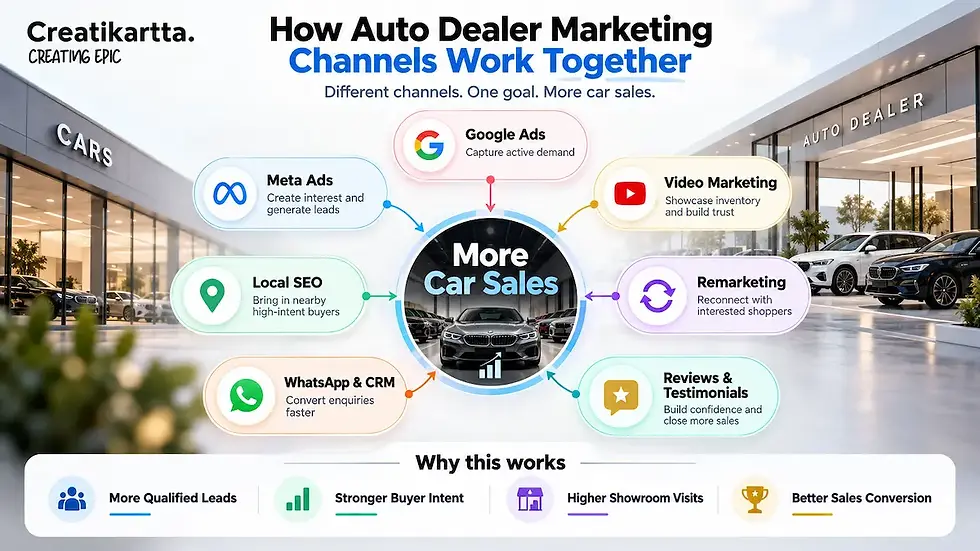
The dealerships that perform best are usually not the ones posting the most content or running the most ads. They are the ones connecting their inventory, advertising, website, follow-up process and sales team into one clear system.
This guide explains how auto dealers can build that system and use digital marketing to generate stronger leads, improve buyer interest and increase the chances of selling more cars.
What Is Auto Dealer Marketing?
Auto dealer marketing is the process of promoting a dealership, its available vehicles and its offers to potential buyers through digital and offline channels. In today’s market, most of that journey happens through platforms such as Google, Instagram, Facebook, YouTube, dealership websites, local search and WhatsApp.
The purpose is not simply to increase visibility. A good dealership marketing strategy should help a potential buyer discover the right vehicle, understand its value, trust the dealership and take a clear next step. That next step could be requesting details, booking a viewing, scheduling a test drive or visiting the showroom.
The most effective dealerships therefore treat marketing as a connected digital marketing funnel rather than a collection of independent campaigns.
Why Auto Dealer Marketing Has Changed
Car buyers are more informed than ever before. They can compare specifications, prices, financing options, ownership costs, reviews and nearby inventory before ever speaking with a salesperson. This means the dealership no longer controls the complete buying conversation.
A buyer looking for a Mercedes, BMW, Toyota or premium pre-owned SUV may interact with several dealerships within a single day. If one business is easier to discover, gives clearer information and responds faster, it already has an advantage before the customer enters the showroom.
This is why the modern dealership needs to focus on both visibility and conversion. Getting attention is useful, but the real value comes from turning that attention into serious conversations, showroom visits and actual sales.
1. Market Individual Cars, Not Just the Dealership
One of the biggest mistakes dealerships make is advertising only the dealership itself. Customers are usually much more interested in a specific car, body type, price range or brand than they are in the name of the showroom.
A buyer may search for a “BMW X1 under ₹40 lakh,” a “pre-owned Mercedes in Dehradun” or a “luxury SUV with low mileage.” That means individual inventory should become a major part of the marketing strategy.
Important cars should have their own reels, carousels, ad creatives, website pages and remarketing campaigns. The content should explain why the vehicle is worth considering rather than simply announcing that it is available.
Useful information can include:
Model and variant
Year and mileage
Key features
Ownership and service history
Price or price range
Finance availability
Exchange options
The more relevant the communication is to the buyer’s actual requirement, the stronger the chance of generating a qualified enquiry.
2. Use Google Ads to Capture High-Intent Buyers
Google Ads can be particularly valuable for dealerships because search behaviour often reveals strong purchase intent. Someone typing “BMW X5 for sale near me” is much closer to buying than someone casually scrolling past a car reel.
This is why search campaigns should focus heavily on terms linked to actual inventory and buying intent. Brand searches, model searches, used-car terms, local dealership searches and budget-based searches can all create strong opportunities when they are matched with the right landing page.
For example, instead of sending every visitor to the homepage, the campaign should take the buyer directly to the most relevant inventory page. A customer searching for a Mercedes should see available Mercedes models, not a generic list of ten different brands.
Examples of High-Intent Searches
Used luxury cars in Dehradun
BMW X1 for sale near me
Mercedes dealership near me
Pre-owned SUV under ₹30 lakh
Audi used car dealer
Best luxury car showroom in Dehradun
Search advertising works best when the journey is simple: query → relevant vehicle → enquiry.
3. Build Meta Ads Around Different Buyer Motivations
Facebook and Instagram are powerful because cars are highly visual products. However, simply boosting attractive photographs is not a complete strategy. Strong Meta campaigns are built around different reasons a customer may want to buy.
One buyer may care about price. Another may want a specific brand. A third may be looking for an upgrade, while a luxury buyer may care more about rarity, condition and specifications. The creative should reflect these differences.
A dealership can test several advertising angles instead of using one generic message repeatedly.

Five Ad Angles Worth Testing
Inventory angle: “BMW X5 now available.”
Price angle: “Luxury SUVs starting under ₹XX lakh.”
Upgrade angle: “Ready to move up from your current car?”
Scarcity angle: “Only one available in this specification.”
Lifestyle angle: “Comfort for the city. Performance for the highway.”
The real goal is not to discover which ad produces the cheapest form submission. It is to identify which message brings the dealership the highest number of serious buyers.
4. Make Short-Form Video a Core Content Format
Cars need to be experienced visually. A static photograph can show what the vehicle looks like, but a good video can help the viewer imagine owning it, sitting inside it and driving it.
Reels and short-form videos should therefore become a core part of the dealership content mix. The best-performing content does not need to be overly complicated, but it should make the vehicle feel desirable and easy to understand.
A strong inventory video can move through a clear sequence:
360° exterior → front and side profile → wheels → interior → dashboard → key features → engine start → driving shot → CTA
The dealership should also avoid making every reel feel like the same catalogue video. Comparisons, ownership tips, new arrivals, customer deliveries and buying advice can make the page much more engaging.
5. Improve Local SEO Before Chasing National Traffic
For most dealerships, location matters. Buyers often search for options close to where they live, work or plan to visit. This makes local SEO one of the strongest long-term opportunities for dealership marketing.
A properly managed Google Business Profile can help the dealership appear for searches such as “car dealership near me,” “luxury car dealer in Dehradun” or “used car showroom nearby.” Business information, phone numbers, opening hours, photographs and customer reviews should always remain accurate.
The dealership website should also include natural location signals across relevant pages. There is little value in trying to rank nationally for broad automotive keywords if the business primarily sells within a defined region.
Local SEO works best when the dealership combines strong location relevance with consistent reviews, updated business information and useful inventory pages.
6. Build Landing Pages for Specific Buyer Intent
Many dealerships spend money on advertising and then waste part of that traffic by sending everyone to the same homepage. This creates unnecessary steps between the advertisement and the enquiry.
If the campaign promotes SUVs, the landing page should show SUVs. If the ad promotes Mercedes inventory, the page should focus on Mercedes. If the user clicked a specific vehicle, they should be taken directly to that vehicle or the closest relevant selection.
A strong dealership landing page should make the following information easy to understand:
What vehicle is available?
What makes it worth considering?
What does it cost?
Why should the buyer trust the dealership?
How can the buyer enquire quickly?
Calls, lead forms and WhatsApp buttons should be visible without forcing the user to hunt for them.
This is where the customer journey in digital marketing becomes important. The advertisement, landing page and sales conversation should feel like parts of the same experience.
7. Use Remarketing to Bring Interested Buyers Back

Most car buyers will not enquire after their first interaction with a dealership. They may still be comparing prices, researching financing, talking to family members or considering another vehicle.
Remarketing gives the dealership another opportunity to continue that conversation. Audiences can be built around website visitors, people who viewed specific inventory, users who watched videos or those who interacted with previous campaigns.
The important part is to change the message as the customer moves closer to purchase. Showing the exact same advertisement repeatedly is rarely enough.
For example, the first ad may say:
“Mercedes C-Class now available.”
A later remarketing ad could say:
“Still considering the C-Class? Book a viewing this week.”
This makes the communication feel more relevant because it responds to the customer’s stage in the buying journey.
8. Be Clear About Price and Vehicle Value
Car buyers want information before they want a sales conversation. When important details are hidden, serious buyers may leave and continue their research elsewhere.
Where appropriate, the dealership should communicate the asking price, model year, kilometres driven, service history, ownership details, warranty, finance availability and exchange options. Transparency helps potential customers decide whether the car fits their requirements before they contact the sales team.
Not every dealership will be able to publish every detail publicly, but there should still be enough information to create genuine interest. Making every post say “DM for price” may increase message volume, but many of those messages may not turn into serious opportunities.
The objective should be qualified conversations, not simply more conversations.
9. Turn Customer Reviews Into Marketing Assets
Buying a car is a high-trust decision. Customers want to know whether the dealership is reliable, whether the vehicle is honestly represented and whether the buying process will be professional.
This is why reviews and customer stories should become an active part of the content strategy. Google reviews, customer delivery videos, photographs, testimonials and repeat-buyer stories can all help reduce hesitation.
A real customer receiving a vehicle can sometimes build more trust than a polished commercial. It gives potential buyers evidence that other people have successfully purchased from the dealership.
Trust Content Worth Creating
Customer delivery reels
Google review highlights
Buyer testimonials
Repeat-customer stories
Vehicle handover photographs
Dealership milestones
The dealership should not only claim to be trusted. It should continuously show evidence of that trust.
10. Connect Every Campaign With Fast Lead Follow-Up
A strong campaign can still fail if the sales process behind it is weak. Many car buyers enquire with multiple dealerships within the same day, which makes response speed extremely important.
If one dealership replies quickly with the right information while another responds several hours later, the faster team already has an advantage. Marketing and sales cannot operate separately if the goal is to increase car sales.
The sales team should know which vehicle the customer enquired about, where the enquiry came from and any information the buyer already provided. The first conversation should then qualify the customer naturally by discussing budget, timeline, financing, exchange requirements and model preference.
Good advertising creates the opportunity. Good follow-up turns that opportunity into a showroom visit.
11. Segment Campaigns by Buyer Intent
Not every potential customer should see the same communication. A first-time car buyer may have different concerns from someone upgrading to a luxury SUV, and both will respond differently to advertising.
Dealerships can segment buyers according to brand preference, budget, body type, upgrade intent, exchange intent or luxury purchase behaviour. This helps both the creative team and sales team communicate more effectively.
A budget-focused customer may care heavily about price and finance options. A luxury buyer may care more about specification, condition, ownership history and exclusivity.
The closer the marketing matches the buyer’s actual priorities, the stronger the quality of the enquiry is likely to be.
12. Measure Sales Quality, Not Just Cost Per Lead
A campaign can generate a very low cost per lead and still perform badly for the dealership. Cheap leads do not automatically mean serious buyers.
Marketing reports should therefore go beyond impressions, clicks and CPL. Dealerships should connect advertising performance with what happens later in the sales process.
Metrics That Actually Matter
Marketing Metric | Business Metric |
Leads generated | Qualified enquiries |
Cost per lead | Cost per qualified lead |
Website clicks | Calls and WhatsApp conversations |
Form submissions | Showroom visits |
Engagement | Test drives |
Campaign conversions | Bookings and sales |
Imagine one campaign generates 100 cheap leads but almost no showroom visits. Another generates only 30 leads, but six of those customers visit the showroom and two purchase cars.
The second campaign is clearly more valuable, even though the CPL may appear higher.
Auto Dealer Marketing: Do This, Avoid This
Do This | Avoid This |
Promote specific inventory | Advertise only the dealership |
Use relevant landing pages | Send everyone to the homepage |
Track qualified leads | Judge success only by CPL |
Respond quickly | Follow up hours later |
Retarget warm audiences | Run only cold campaigns |
Refresh creatives regularly | Use the same car ad repeatedly |
Show real customer proof | Depend only on polished ads |
This simple difference in approach can completely change the quality of dealership marketing. The goal is not simply to be visible everywhere, but to make every touchpoint useful for the potential buyer.
Common Auto Dealer Marketing Mistakes
Many dealership campaigns struggle because they focus heavily on generating activity without considering what happens after that activity. High reach, more followers and more leads can look positive, but they do not automatically translate into more sales.
Some of the most common problems include poor audience segmentation, repetitive creatives, weak landing pages, unclear pricing, slow WhatsApp responses and no proper remarketing system. Another major mistake is measuring every campaign only according to cost per lead.
Dealerships should regularly review the entire customer journey and identify where serious buyers are dropping out. Sometimes the real problem is not the advertisement at all. It may be the page, the sales response or the lack of follow-up.
Which Marketing Channel Works Best for Car Dealerships?
There is no single platform that works best for every dealership. Each channel plays a different role in the customer journey, which is why stronger strategies usually combine several of them.
Channel | Buyer Intent | Speed of Results | Best Use |
Google Ads | Very High | Fast | Capturing active searches |
Meta Ads | Medium–High | Fast | Discovery and retargeting |
Local SEO | High | Medium | Nearby dealership searches |
Website SEO | High | Slower | Long-term organic traffic |
Reels and Video | Medium | Medium | Desire and brand recall |
Very High | Immediate | Lead conversion | |
CRM / Email | Medium–High | Medium | Follow-up and nurturing |
The right mix depends on the dealership’s location, inventory, average car value, target buyer and sales process.
Frequently Asked Questions About Auto Dealer Marketing
What is the best marketing strategy for a car dealership?
The strongest strategy combines high-intent channels such as Google Search and local SEO with visual platforms such as Instagram and Facebook. Those channels should then connect to relevant inventory pages, remarketing and fast sales follow-up. The goal is to create a complete path from discovery to enquiry and eventually to sale.
Do Facebook and Instagram Ads work for car dealerships?
Yes. Meta Ads can work particularly well for inventory promotion, brand awareness, lead generation and remarketing. Their effectiveness depends on creative quality, targeting, the vehicle offer, landing experience and how quickly the dealership handles the enquiry after it arrives.
How can a car dealership generate more qualified leads?
Dealerships can improve lead quality by targeting stronger purchase intent, promoting relevant inventory and giving customers enough information before they enquire. Google Ads, Meta Ads, local SEO, inventory pages, video content and remarketing can all support this process when they are connected properly.
Is SEO useful for car dealerships?
Yes. SEO can help dealerships appear for searches related to available vehicles, local dealership categories and buyer intent. Local SEO is especially valuable because many customers search for cars and showrooms within a specific city or region.
What should dealerships track in digital marketing?
Dealerships should track qualified enquiries, calls, WhatsApp conversations, showroom visits, test drives, finance discussions, bookings and actual sales. Reach, impressions and cost per lead are still useful, but they should not be treated as the final measure of success.
Final Thoughts
The best auto dealer marketing strategies do not depend on one ad, one platform or one viral reel. They depend on how well the entire customer journey is connected.
A potential buyer should be able to discover the right vehicle, understand its value, trust the dealership, enquire easily and receive a quick response. Search marketing, social media, SEO, content, remarketing, landing pages and sales follow-up should all support that journey.
When these parts work together, digital marketing stops being only a source of clicks and starts becoming a real sales system.
At Creatikartta, we build marketing around business outcomes rather than vanity metrics. From performance marketing and lead-generation funnels to SEO, content, retargeting and digital strategy, the goal is to connect the right customer with the right offer and move them closer to a measurable business action.
If your dealership is getting visibility but not enough qualified enquiries, showroom visits or sales, the solution may not be more advertising. It may be a better-connected marketing system.


Comments